Sunday, December 31, 2006

Chick-Pea, Chicken, and Rice Soup from Aleppo

My sister and her family visited over the holidays and we did a lot of cooking together. She made this delicious soup from the Mediterranean Diet Cookbook: A Delicious Alternative for Lifelong Health by Nancy Harmon Jenkins.

This soup has been a favorite since I first had it years ago in a restaurant off Hamra Street in Ras Beirut that specialized in cuisine from Aleppo. The cinnamon marks it as from the region of the Lebanese-Syrian-South Turkish littoral, where flavors that we associate with sweet cakes and cookies, like cinnamon, clove, and allspice, are used very successfully in soups and stews. Don't let the simplicity of this deceive you--it's an astonishingly good dish for cold days and nights.

Ingredients:
  • ¾ cup dried chick-peas, soaked overnight **
  • 2 quarts clear white chicken stock with the breast meat of the cooked chicken diced and reserved
  • ½ cup long-grain [brown] rice **
  • 1 medium onion, chopped
  • 2 garlic cloves, minced
  • 2 tablespoons extra-virgin olive oil
  • 1 teaspoon ground cinnamon
  • ½ teaspoon ground cumin
  • [sea] salt and freshly ground black pepper to taste

Directions:

In a covered heavy kettle or stockpot, simmer the drained chick-peas in the chicken stock for an hour or more, until they are thoroughly cooked but not falling apart. Add the rice and continue cooking until the rice is tender but not bursting, 15 to 20 minutes. Stir in the reserved chicken and continue cooking just long enough to heat it through. Taste the stock and adjust seasoning if necessary. Cover and keep warm.

In a small skillet, gently sauté the onion and garlic in the oil until soft but not browned--about 10 to 15 minutes. Stir in the cinnamon and cumin and cook 5 minutes longer or until the aroma of the spices begins to rise. Stir the mixture into the soup, return to a simmer, taste, adding salt and pepper, and serve immediately.

Makes 6 to 8 servings.


Although this recipe is from Syria, it reminds me very much of some dishes I encountered when I first moved to Turkey in the early 1990s. My husband and I lived in Antalya, on the southern Mediterranean coast, and I had a great friend who was also an American married to a Turk. She and I would share lots of Turkish recipes and she had one that I thought most unusual, but extremely delicious--it used cinnamon as the flavoring in a meat/rice dish. I'll try to track that recipe down, or one like it, and post it here as well.

** I like to soak both my rice and chick-peas overnight. Soak in water with a couple of tablespoons of liquid whey added to aide in the lactic acid fermentation. Read an article by Sally Fallon at the Weston A. Price Foundation for a good explanation of this process, or check out her wonderful cookbook, packed with nutritional information as well as great recipes: Nourishing Traditions.

Tuesday, December 26, 2006

St. Nicholas of Myra


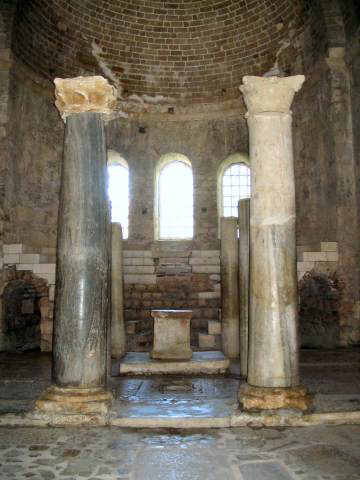
Did you know Santa Claus was originally from Turkey? Well, actually, Asia Minor didn't fall under Ottoman control until a few centuries later, but Nicholas was Bishop of Myra, outside present day Demre on the south-western Mediterranean coast of Turkey. I went to visit the ruins of Myra and the church built in his honor when we lived in Antalya.

St. Nicholas is best remembered and revered for his generosity. Numerous legends abound of him giving money and aid to people in need. One of the most popular, and most tied to the Santa Claus story, is of how St. Nicholas tossed gold at night into the window of a poor family in order to give the three daughters a dowry.

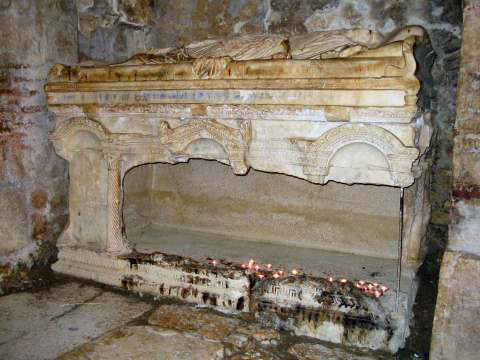
At the time Myra fell under Seljuk Muslim control, raiders from Italy stole the bones of St. Nicholas from his tomb (see picture at right, note where it was broken into) in his church and brought the bones to Bari. A few small pieces that were left behind are on display in the museum in Antalya.

There are some wonderful icons at the church in Myra, but unfortunately they are not in the best preserved shape. Still, the church is largely intact, and coupled with the wonderful rock-cut tombs and theater at nearby Demre is a wonderful place to visit should you get the chance.


For more on St. Nicholas of Myra check out:
Sain Nicholas on Wikipedia
St. Nicholas of Myra, Legends and Sources

Saturday, December 09, 2006

Stuffed Foods -- Dolmalar

Here's the first in a series of recipes translated from a collection by my Turkish mother-in-law.

Dolmas -- stuffed foods, usually vegetables -- are a delicious mainstay of the Turkish Diet. Turks will stuff almost any vegetable, and many fruits, that stays still long enough to get caught. :-) The choice of what to stuff today is usually determined by what can be bought fresh at the pazar -- the open air farmer's market. During the winter, when little is fresh, they'll stuff dried versions of many of their favorite vegetables.

Here is my mother-in-law's recipe for the basic process of preparing a variety of foods with meat stuffing. Keep in mind that I use the term "recipe" loosely. She's the type of well-experienced cook who chooses by what ingredients are available and measures by what feels right.

Also for your convenience, here's a list of ingredients:
1 pound ground beef
1 cup rice (she uses white, I would choose brown)
2 medium onions
bunch of fresh parsley
small bunch fresh mint
small bunch fresh dill
2 tomatoes
vegetable to stuff (see list below -- you'll need enough to fill a fairly large pot)
olive oil -- enough to cover bottom of pot
tomato paste -- about 1 well-rounded tablespoon
water -- enough to fill pot and cover the dolma


There are two types of dolma -- with olive oil (served cold) and with meat (served hot).

Meat stuffed vegetables:
bell pepper, eggplant, tomatoes, zucchini and artichoke can all be used for stuffing.

Preparing the Stuffing:
For one pound ground beef, add 1 cup of well-washed rice and 2 medium sized onions, chopped. The onion should be chopped very fine. Chop the parsley, mint and dill and add to the ground beef. Grate two tomatoes and add to ground beef with black pepper.

Next, empty the inside of the vegetables (for example, cut the top off a bell pepper and empty and wash out the inside). Then fill the empty vegetable with stuffing.

Cooking:
Put oil in a large pot and add tomato paste, stirring it in. After a while, add water into the stirred paste, and warm the water. You should add enough water to cover the dolmas. Cook until tender and rice is done.

If you want the dolma to cook better, cover them with a porcelain or heavy plate, something that presses slightly down on the dolma so that the stuffing will hold together better.

Portrait of a Turkish Woman

My Turkish mother-in-law is a very special woman. She has survived the death of two husbands, raised three wonderful children, cared for an ailing mother for years (then an ailing brother followed by her husband) -- and still at 78 she has the strength, energy, and spirit of a woman half her age.

When I first moved to Turkey in the early 1990s, my husband and I lived for several months with his parents in Ankara until he started his position in the university in Antalya. While I always loved and respected my mother-in-law, I will have to admit that as a result of culture shock and cultural differences, I didn't always recognize and appreciate her advice on food preparation or nutrition (not to mention in other areas!). Now I'm happily eating my words -- as well as her recipes.

I still prefer to drink my milk cold first thing in the morning (she insisted cold milk would give me a sore throat), but now I wish I could buy the good, fresh, raw milk by just yelling to the sütcu passing outside my window every morning as she did. I've learned the value of slow food preparation, fermented vegetables and drinks, as well as lots of healthy fish and a salad at every meal (including breakfast!).

So, when my husband traveled to Turkey recently, I asked his mother to write down as many recipes and traditional nutritional advice as she could remember. I'll be sharing these with you over the next few weeks.

Thank you, Anne! (Anne is the Turkish word for mother.)

Wednesday, December 06, 2006

Pope in Turkey

Well, I didn't see any news coverage as to what Pope Benedict ate during his recent trip through Turkey, but it was very interesting to me to follow his journeys to places I've both visited before and also written about in my novels.

First, Anıtkabir, the mausoleum of the modern Republic of Turkey's founder and first president, Mustafa Kemal Atatűrk -- is literally just a couple of blocks from where my husband grew up and I first lived in Turkey when we stayed with his parents. I haven't written about Anıtkabir in a story though...yet.

Then, near the Aegean Coast outside Ephesus, Meryem Ana Evi, or The House of the Virgin Mary -- I absolutely love Ephesus and this nearby site. If you ever go to Turkey, in my opinion, Ephesus is a must. Here's a link direct to Ephesus as well.

I have definitely used Meryem Ana in a story -- a story I started writing a few years ago. Now my fear is that it will seem I cashed in on the Pope's visit. Oh, well.

Although the Pope only briefly visited Haghia Sophia in Istanbul, it's a fabulous church/mosque/museum that I also highly recommend to anyone visiting Turkey. The history of this church, and its mosaics, are truly inspirational.

A couple of years ago, I visited the Met in New York City. Imagine my surprise when I turned around, and over the door in one of the rooms, found myself staring at a recreated mosaic from Haghia Sophia.

Haghia Sophia figures into the same story in which I used the House of the Virgin Mary. Across the street from Haghia Sophia is the Blue Mosque, Sultanahmet Camii, which the Pope also visited. I've used the Blue Mosque as a setting for another novel I've written.

Wonder if the Pope made it to the Covered Bazaar, and if he got invited to drink Turkish tea while examining a Turkish carpet? :-)
Related Posts Plugin for WordPress, Blogger...