Take a music break and watch this music video from one of my favorite Turkish artists, Mustafa Sandal. Enjoy the sites around Turkey, especially Istanbul.
This one is a bit different, but interesting.

A Turkish kitchen full of wonderful traditional foods with delightful nougats of Turkish culture.

Showing posts with label Cultural Notes. Show all posts
Showing posts with label Cultural Notes. Show all posts
Wednesday, September 03, 2008


Wednesday, April 23, 2008
Happy Children's Day

Today is Children's Day in Turkey -- a national holiday established by the Republic's founder, Mustafa Kemal Ataturk, to celebrate children and help their elders to remember it is our responsibility to guarantee them a peaceful future.
Children's Day is celebrated in Turkey with children taking the lead in some government offices, folk dances, parades, and kids get this -- NO SCHOOL!
So, happy Children's Day, one and all, to kids in Turkey, China, Ethiopia, Iraq, US, and everywhere!
Friday, January 18, 2008
Ode to Kokorec and the Southern - Turkish Bond
Turks and Southerners have a lot in common. I've learned this well over the 23 years since I first met a Turk and started experiencing Turkish culture. For one, both American Southerners and Turks like to stuff their guests with food. I'd never met anyone who could compete with my Southern grandma for number of dishes she set on a dinner table...until I met my Turkish mother-in-law. Honestly, I think my grandma still comes out the winner, but not by much, and that's mainly because Grandma had a bigger table allowing her to cover more space.
Two, Turks take great pride in their cuisine, just like Southerners do--and both rightly so. The Turkish cook prides herself on a wide variety of fresh ingredients prepared in a healthy and delicious manner. All types of greens are cooked or eaten raw in salad, even those many consider weeds, such as arugula (roka), purslane (semizotu) and tere--a type of cress. The Southerner can identify with this with our love of collards, mustard and turnip greens, and for some, even poke salad. It's also been my experience that most Turks and Southerners love to cook their vegetables until practically mush. "Al dente" has no meaning here.
And finally, Turks eat lamb like Southerners eat pork--every part of it prepared in many different ways, including--some of you guys may want to cover your eyes a sec--the testicles. You may find this hard to believe, but the food my son enjoyed the most in Turkey this past summer was kokorec -- a street sandwich made of roasted lamb's intestines, sprinkled with cumin and red pepper and served on a half-loaf of warmed crusty bread. Kokorec is the Turkish version of chitterlings (commonly called chit'lins), or vice versa since the kokorec propabably predates chit'lins.
I've eaten both. I like kokorec better. But then chit'lins might be just as good if they were roasted. The only way I've had them before was boiled and then fried. And it's been years since I've eaten chit'lins, not since my Grandma died.
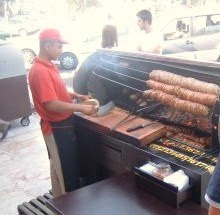
So, if you get a chance to visit Turkey, look for a street vendor like the one above, and don't hesitate. Set any queasiness aside and enjoy this humble delicacy. For Southerner and Turk alike, kokorec and chit'lins are a traditional food of the country person, the poor, those who couldn't let a scrap of food or any part of the animal go to waste.
Just for fun, here's a YouTube video showing the rhythm of preparing kokorec:
And finally, here's an interesting article on the Turks' love of kokorec that you might find interesting.
Two, Turks take great pride in their cuisine, just like Southerners do--and both rightly so. The Turkish cook prides herself on a wide variety of fresh ingredients prepared in a healthy and delicious manner. All types of greens are cooked or eaten raw in salad, even those many consider weeds, such as arugula (roka), purslane (semizotu) and tere--a type of cress. The Southerner can identify with this with our love of collards, mustard and turnip greens, and for some, even poke salad. It's also been my experience that most Turks and Southerners love to cook their vegetables until practically mush. "Al dente" has no meaning here.
And finally, Turks eat lamb like Southerners eat pork--every part of it prepared in many different ways, including--some of you guys may want to cover your eyes a sec--the testicles. You may find this hard to believe, but the food my son enjoyed the most in Turkey this past summer was kokorec -- a street sandwich made of roasted lamb's intestines, sprinkled with cumin and red pepper and served on a half-loaf of warmed crusty bread. Kokorec is the Turkish version of chitterlings (commonly called chit'lins), or vice versa since the kokorec propabably predates chit'lins.
I've eaten both. I like kokorec better. But then chit'lins might be just as good if they were roasted. The only way I've had them before was boiled and then fried. And it's been years since I've eaten chit'lins, not since my Grandma died.

So, if you get a chance to visit Turkey, look for a street vendor like the one above, and don't hesitate. Set any queasiness aside and enjoy this humble delicacy. For Southerner and Turk alike, kokorec and chit'lins are a traditional food of the country person, the poor, those who couldn't let a scrap of food or any part of the animal go to waste.
Just for fun, here's a YouTube video showing the rhythm of preparing kokorec:
And finally, here's an interesting article on the Turks' love of kokorec that you might find interesting.
Saturday, October 20, 2007
Eye of Horus and Nazar Boncuk (Nazar Boncugu)
As anyone who has read any of my Harry Potter analysis essays will know, I'm fascinated by the Eye of Horus. I've written a series of editorials on Mugglenet.com (pre-Deathly Hallows) that analyzed Egyptian Myths in the Harry Potter series, including the Eye of Horus.

One thing that's always struck me was how similar the Turkish nazar boncuk (below) looks compared to the Egyptian Eye of Horus (above). The single, staring eye, with black pupil, surrounded by white and shades of blue, warding off evil--to me, it seems obvious that the nazar boncugu is a direct descendant of the Eye of Horus, However, I've found very little online making this a direct link. Perhaps this is because most of the information would be in Turkish, or perhaps it's just so obvious that no one feels a need to analyze it.
But I do. I find it fascinating that we have an amulet, very much alive and in constant use today, that is descended from an amulet worn by ancient Eygptians (and Sumerians and Hitittes) 4,000 - 5,000 years ago! That's one powerful amulet!

So, if you know more details of the history of how the Eye of Horus traveled from Egypt to Turkey to become the nazar boncuk, I'd love to hear it!

One thing that's always struck me was how similar the Turkish nazar boncuk (below) looks compared to the Egyptian Eye of Horus (above). The single, staring eye, with black pupil, surrounded by white and shades of blue, warding off evil--to me, it seems obvious that the nazar boncugu is a direct descendant of the Eye of Horus, However, I've found very little online making this a direct link. Perhaps this is because most of the information would be in Turkish, or perhaps it's just so obvious that no one feels a need to analyze it.
But I do. I find it fascinating that we have an amulet, very much alive and in constant use today, that is descended from an amulet worn by ancient Eygptians (and Sumerians and Hitittes) 4,000 - 5,000 years ago! That's one powerful amulet!

So, if you know more details of the history of how the Eye of Horus traveled from Egypt to Turkey to become the nazar boncuk, I'd love to hear it!
Saturday, September 22, 2007
Kuru Yemis -- Turkish Gorp
Americans didn't invent trail mix. Turks have been eating it for centuries.
During my family's recent summer visit to Turkey, I was reminded of one thing I loved during my years of living in that country, which, unfortunately, is being encroached upon. Turks eat very little junk food. Though they love their desserts after dinner, for snacks during the day, they naturally reach for fruit or a handful of what they call kuru yemis, which translates as "dry snack."
Kuru yemis is a very wholesome, healthy mixture of dried fruits and nuts. It's a traditional staple in almost every home, and is gobbled down by young and old alike.
You'll see people walking down the street, dipping their hand in a pocket, then popping a seed or a nut into their mouths. School children carry them in their lunch bags. And many dinner guests in a Turk's home are greeted with bowls of dried nuts and fruits.
Kuru yemis is as varied as the host who puts it together for their guests and mothers who pack it with their children's lunches. It's any combination of a variety of dried fruits and nuts, which are plentiful and convenient throughout the whole of Turkey.
Here's a list of some typical ingredients:
peanuts (salted in their skins)
almonds
pistachios
hazlenuts
leblebi (roasted chickpeas)
raisins
sunflower seeds
pumpkin seeds
Not as common, though can be included, are other dried fruits such as apricots, dates, and figs, but any dried fruit or nut can be included.
Almost all of these nuts and fruits can be found in the US. For good quality dried apricots and dates, you'd want to visit your whole foods or natural grocer. And if you're lucky enough to have a mid-eastern grocery nearby, you can probably find leblebi as well.
So, dip in, and have a snack attack, Turkish style!

photo credit: http://www.sihirlitur.com/haber/cerez_haritasi/index.html
During my family's recent summer visit to Turkey, I was reminded of one thing I loved during my years of living in that country, which, unfortunately, is being encroached upon. Turks eat very little junk food. Though they love their desserts after dinner, for snacks during the day, they naturally reach for fruit or a handful of what they call kuru yemis, which translates as "dry snack."
Kuru yemis is a very wholesome, healthy mixture of dried fruits and nuts. It's a traditional staple in almost every home, and is gobbled down by young and old alike.
You'll see people walking down the street, dipping their hand in a pocket, then popping a seed or a nut into their mouths. School children carry them in their lunch bags. And many dinner guests in a Turk's home are greeted with bowls of dried nuts and fruits.
Kuru yemis is as varied as the host who puts it together for their guests and mothers who pack it with their children's lunches. It's any combination of a variety of dried fruits and nuts, which are plentiful and convenient throughout the whole of Turkey.
Here's a list of some typical ingredients:
peanuts (salted in their skins)
almonds
pistachios
hazlenuts
leblebi (roasted chickpeas)
raisins
sunflower seeds
pumpkin seeds
Not as common, though can be included, are other dried fruits such as apricots, dates, and figs, but any dried fruit or nut can be included.
Almost all of these nuts and fruits can be found in the US. For good quality dried apricots and dates, you'd want to visit your whole foods or natural grocer. And if you're lucky enough to have a mid-eastern grocery nearby, you can probably find leblebi as well.
So, dip in, and have a snack attack, Turkish style!

photo credit: http://www.sihirlitur.com/haber/cerez_haritasi/index.html
Tuesday, August 14, 2007
Turkish Women Making Gozleme

Above is a great picture of some Turkish women in village dress rolling out lavas to make gozleme for the tourists near Ephesus. Gozleme is a type of traditional fast food that is popular for lunch.

Gozleme is almost like a quesadilla, except it's made from lavas (a wheat flour dough rolled out into paper-thin circles) The lavas is then filled with any combination of several savory topping -- white cheese, spinach, parsley, ground beef and onions -- and baked on a griddle.

I'm including this here as a cultural note rather than a recipe, because gozleme as I've seen it is almost always made with white flour, and I avoid that. However, a healthier version of gozleme would be to use sprouted wheat tortillas, which you can find at may health food stores, and then fill with your own healthy toppings.
Saturday, April 14, 2007
Turkish Pop Music -- Mustafa Sandal and Yasar
I thought I'd give you all a taste of some modern Turkish culture with a couple of clips from some of my favorite Turkish singers.
I absolutely love "Divane" by Yasar. The guitar, the singing, and the atmosphere are fantastic.
This song, "Jest Oldum," is from Mustafa Sandal (Musti). Musti is one of the most popular Turkish pop singers.
Both of these are from 1996 because that's during the time I was living there. Yasar and Musti both have more recent stuff out, but these are two of my favorites.
I absolutely love "Divane" by Yasar. The guitar, the singing, and the atmosphere are fantastic.
This song, "Jest Oldum," is from Mustafa Sandal (Musti). Musti is one of the most popular Turkish pop singers.
Both of these are from 1996 because that's during the time I was living there. Yasar and Musti both have more recent stuff out, but these are two of my favorites.
Wednesday, February 28, 2007
My Favorite Turkish Meal
Two of the foods I think Turks excel at come together beautifully to form my absolute favorite Turkish meal: fish and greens. I've never eaten fish as good as in Turkey. Maybe it's the quality of the fish -- salt water fish freshly caught -- or maybe it's the way the Turks prepare them. Either way, Turkey is blessed with four seas (Black, Marmara, Aegean, and Mediterranean) and a wide variety of excellent seafood.
Then, they've learned over centuries the best way to prepare the fish and the best foods to serve the fish with to enhance their flavor. And the most popular seafood accompaniment is a simple green salad, or preferably several varieties of salad. Turks will make a salad out of any vegetable. And unlike the loaded salad bar with heavy dressing that most Americans are used to, most Turkish salads are made out of one or two very fresh vegetables, thinly sliced or shredded, and topped lightly with salt and an olive oil/lemon juice dressing.
Some of my favorite fish I ate in Turkey:
Some of the most elegant Turkish meals I had were based simply on fish and salad. I remember the dinner following our niece's wedding at my sister-in-law's home. She'd prepared a huge platter of istavrit (horse mackerel), battered and lightly fried. This was accompanied by 4-5 different greens or salads: a plate of whole green onions, a large bowl of whatever greens she could find mixed together, a salad of chopped parsley, and a platter of salted whole romaine leaves.
When a fish is battered, it's usually coated in corn meal, salt, and pepper, and it's almost always fried in olive oil. My husband says that the most important thing to accompany fish, besides the greens, are onions, either green or dry, because the taste of onion brings out the full flavors of the fish.
Besides being nutritious, this simple, elegant meal is also incredibly nutritious. For more information on the variety of fish served in Turkey, check out this website: Seafish in Turkey.
Then, they've learned over centuries the best way to prepare the fish and the best foods to serve the fish with to enhance their flavor. And the most popular seafood accompaniment is a simple green salad, or preferably several varieties of salad. Turks will make a salad out of any vegetable. And unlike the loaded salad bar with heavy dressing that most Americans are used to, most Turkish salads are made out of one or two very fresh vegetables, thinly sliced or shredded, and topped lightly with salt and an olive oil/lemon juice dressing.
Some of my favorite fish I ate in Turkey:
- lufer -- from the Black Sea and Maramara. Even though lufer is translated as blue fish, I believe there must be something different from the Turkish variety and those available in the US, because the one time I ate blue fish in the US, I didn't like it at all. I first ate lufer in Turkey on an evening picnic with a childhood friend of my husband, grilled over an outside bar-b-que and served with lots of green onions and a salad of shredded romaine lettuce. I decided I could eat this simple meal every day for the rest of my life and be very happy. Lufer is one of the most popular fishes in Turkey. You'll find it featured in many fine restaurants. It can be prepared both grilled and lightly fried.
- mezgit -- Even though mezgit (blue whiting) is from the Aegean and Mediterranean, the first time I had it was in an outside restaurant on the shores of the Black Sea. It was served lightly battered and fried with a parsley, red onion and sumach salad. I decided I had to have two favorite Turkish fish dishes as the mezgit was just as delicious as the lufer.
- hamsi -- anchovy. If all you've ever had of anchovy come from little tin cans or on top of a pizza, then you're in for a true delight if you ever get to try fresh Turkish anchovy. The best hamsi from the Black Sea. I first ate a plate-full of this little fish in the home of my mother and father in-law. I initially turned up my nose at eating the whole of the small fish, head and all, but after I tried it, I couldn't stop myself from eating more. It was like scarfing down chips or popcorn. They're just so delicious, you can't stop.
Some of the most elegant Turkish meals I had were based simply on fish and salad. I remember the dinner following our niece's wedding at my sister-in-law's home. She'd prepared a huge platter of istavrit (horse mackerel), battered and lightly fried. This was accompanied by 4-5 different greens or salads: a plate of whole green onions, a large bowl of whatever greens she could find mixed together, a salad of chopped parsley, and a platter of salted whole romaine leaves.
When a fish is battered, it's usually coated in corn meal, salt, and pepper, and it's almost always fried in olive oil. My husband says that the most important thing to accompany fish, besides the greens, are onions, either green or dry, because the taste of onion brings out the full flavors of the fish.
Besides being nutritious, this simple, elegant meal is also incredibly nutritious. For more information on the variety of fish served in Turkey, check out this website: Seafish in Turkey.
Saturday, December 09, 2006
Portrait of a Turkish Woman
My Turkish mother-in-law is a very special woman. She has survived the death of two husbands, raised three wonderful children, cared for an ailing mother for years (then an ailing brother followed by her husband) -- and still at 78 she has the strength, energy, and spirit of a woman half her age.
When I first moved to Turkey in the early 1990s, my husband and I lived for several months with his parents in Ankara until he started his position in the university in Antalya. While I always loved and respected my mother-in-law, I will have to admit that as a result of culture shock and cultural differences, I didn't always recognize and appreciate her advice on food preparation or nutrition (not to mention in other areas!). Now I'm happily eating my words -- as well as her recipes.
I still prefer to drink my milk cold first thing in the morning (she insisted cold milk would give me a sore throat), but now I wish I could buy the good, fresh, raw milk by just yelling to the sütcu passing outside my window every morning as she did. I've learned the value of slow food preparation, fermented vegetables and drinks, as well as lots of healthy fish and a salad at every meal (including breakfast!).
So, when my husband traveled to Turkey recently, I asked his mother to write down as many recipes and traditional nutritional advice as she could remember. I'll be sharing these with you over the next few weeks.
Thank you, Anne! (Anne is the Turkish word for mother.)
When I first moved to Turkey in the early 1990s, my husband and I lived for several months with his parents in Ankara until he started his position in the university in Antalya. While I always loved and respected my mother-in-law, I will have to admit that as a result of culture shock and cultural differences, I didn't always recognize and appreciate her advice on food preparation or nutrition (not to mention in other areas!). Now I'm happily eating my words -- as well as her recipes.
I still prefer to drink my milk cold first thing in the morning (she insisted cold milk would give me a sore throat), but now I wish I could buy the good, fresh, raw milk by just yelling to the sütcu passing outside my window every morning as she did. I've learned the value of slow food preparation, fermented vegetables and drinks, as well as lots of healthy fish and a salad at every meal (including breakfast!).
So, when my husband traveled to Turkey recently, I asked his mother to write down as many recipes and traditional nutritional advice as she could remember. I'll be sharing these with you over the next few weeks.
Thank you, Anne! (Anne is the Turkish word for mother.)
Monday, October 09, 2006
A Well-Stocked Turkish Kitchen
My husband returned from Turkey yesterday from a 3-week visit (part of the reason I didn't blog as I was so busy with extra work), and brought me several goodies. Olives, feta (beyaz peynir), pastırma, dried apricots (unsulphured) -- lots of good, healthy stuff.
So, I thought I would create a list of the well-stocked Turkish kitchen, ingredients so common on the table, that a Turkish cook would almost always have them in the cupboard, or buy them fresh frequently.
I'm sure this list will grow as I remember certain items, or someone reminds me. Plus Turkey is a huge country and I did not experience all the various regional cuisines, unfortunately.
So, I thought I would create a list of the well-stocked Turkish kitchen, ingredients so common on the table, that a Turkish cook would almost always have them in the cupboard, or buy them fresh frequently.
- Oils:
- olive oil (extra virgen, cold pressed best)
- butter (the real stuff, not that nasty margarine)
- Dairy:
- milk (sometimes still sold fresh off the street)
- feta (beyaz peynir)
- yogurt (and lots of it, whole milk)
- Meats (usually used sparingly because of cost):
- lamb
- pastırma
- ground beef
- Fish
- lufer (a type of blue-fish, but a whole lot better)
- anchovy
- sardines
- trout
(This is just a small selection. As Turkey is surrounded by 3 seas (Mediterranean, Aegean, and Black) plus many rivers, there is a wide variety of fish, and it's eaten frequently. I've never eaten better fish than in Turkey.)
- Fruits--all kinds, whatever's fresh in-season:
- quince
- apricots
- peaches (from Bursa are heavenly)
- grapes
- apples
- pears
- figs (another fruit divinity)
- lemons (used in almost anything, freshly-squeezed, not bottled)
- olives (most commonly served at breakfast, but really at any meal)
Turks love fruit, and use it as a common dessert
- Dried Fruits:
- dates
- apricots
- figs
- raisins
- Nuts (I'll blog about kuru yemiş one day):
- almonds
- pistachios
- walnuts
- hazelnuts
- peanuts
- Vegetables (again, what is fresh and in-season):
- eggplant
- leeks
- tomatoes
- okra
- celeriac
- squash
- carrots
- onions
- cabbage
- garlic (used year-round in almost everything)
- Beans, Legumes and Grains:
- white dry beans (canneli)
- chick peas
- lentils
- bulgur
- rice (Turks usually use white, but I always use brown)
- Greens:
- arugula
- purslane
- lettuce (usually Romaine)
- parsley (used as a salad, too)
- tere
- green onions
- Herbs & Spices:
- dill
- parsley
- mint
- pepper paste
- Drinks:
- tea (loose leaf, black)
- coffee (Turkish ground)
- dried ihlamur/ linden flowers (makes a great tea)
- rakı (a type of Turkish alcohol)
- Misc:
- eggs
- honey
- tarhana (a base used to make a delicious soup)
I'm sure this list will grow as I remember certain items, or someone reminds me. Plus Turkey is a huge country and I did not experience all the various regional cuisines, unfortunately.
Subscribe to:
Posts (Atom)
