Showing posts with label Touring Turkey. Show all posts

Tuesday, March 18, 2008

Bodrum

Spring is coming to North Carolina and with it my thoughts turn to springtime and summers along the coast in Turkey. So, I thought I'd share some beautiful, inspiring pictures with you.


(http://www.living-turkey.com/living_in_bodrum/bests_of_bodrum.htm)

Bodrum is my favorite city in Turkey, and someday we hope to have a vacation home there. Located where the Aegean meets the Mediterranean, Bodrum is a lovely city of low-rise white-washed buildings, beautiful mountain-meets-sea vistas, and an eclectic menagerie of local Turks, artistic liberal Turks who have chosen to make their home here, and tourists from all over the world, especially western and northern Europe.

Home of one of the seven wonders of the ancient world -- the mausoleum -- one of the biggest site-seeing opportunities is the Crusader castle located in the center of the harbor. Many of the mausoleum's columns and building blocks were recycled into the building of the castle.


http://e-turkey.net/v/mugla_bodrum_peninsula/bodrum_halicarnassos_castle3.jpg.html?g2_GALLERYSID=265fc66e903280c485cda6c08dc400c0

Bodrum provides an excellent central location from which to explore the abundant ruins dotting Turkey's ample Aegean and Mediterranean coastline. Within a few hours drive, you can view the tomb and church of St. Nicholas, explore the immense ruins of the ancient city of Ephesus, or head inland to the wonderful natural thermal spas of Pamukkale. Or you can hop on a boat and cruise the Turkish Riviera, including many nearby Greek islands.


http://www.zephyriayachting.com.tr/burcu_zafer.htm

I know I sound like a travel agent, but I love this city. If you ever get a chance to go -- take me along and I'll be your tour guide! :-)

Saturday, December 15, 2007

Updated St. Nicholas of Myra

Last year, I posted an entry about St. Nicholas of Myra, but thought a seasonal update might be interesting.

As mentioned in the last post, St. Nicholas was an early Christian saint who served as bishop to a then thriving port city, Myra, which is in modern-day Turkey. He was revered for his generosity and kindness, especially to children.

Nicholas reportedly attended the First Council of Nicaea, which was held in 325 CE in what is the modern city of Iznik, Turkey. This council is best known for its opposition of Arianism (the belief that Jesus was created by God and not divine himself), and the establishment of the Nicene Creed, which is still said in many churches today.

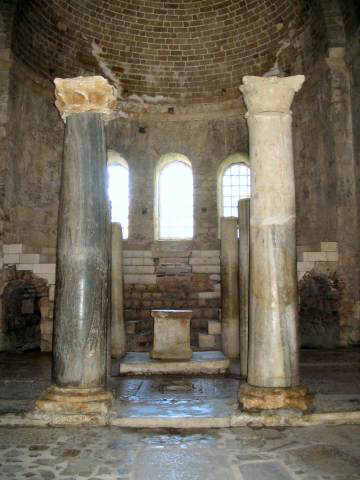
One thing I forgot to include in my original post were a couple of pictures of the frescoes in the church of St. Nicholas. The church was built sometime in the sixth century CE, and repaired many times since. The frescoes are not in the best of shape, but still quite beautiful and interesting. As the pictures I took of the church when I visited in the early 1990s were not digital, I've used pictures from Sacred-Destination.com.

This first fresco of the apostles covers the ceiling of the dome. The dark blue of the background must have been quite striking when it was fresh.


This fresco from a niche in the church is, I think, of Nicholas.


And here is the exterior of the church, showing both the older sections and some newer additions.

Wednesday, September 19, 2007

A Few Left-Over Pictures

As I've uploaded most of the pictures of interest from this summer's trip to Turkey, I thought I'd post just a few that didn't fit into any of my prior posts, but that I think are interesting or beautiful.

I wonder if these Turkish kitties feel very protected sleeping near this wide assortment of nazar boncuk?


Here's a spectacular view of some vacation homes on the hills of the Aegean.


And this picture is taken looking out to the Aegean from one of those homes, owned by my brother-in-law.


Saturday, September 01, 2007

Pamukkale -- Hierapolis

Even though I lived in Turkey for years, it was during my visit this summer that I first visited Pamukkale, a UNESCO World Heritage Site. There are some Greek/Roman ruins (Hierapolis) to see here as people since antiquity have enjoyed and worshiped at this natural phenomenon. As our time was short, I did not get to explore the remains of Hierapolis, but hope to do so next time.

The biggest attraction here, however, are the white mineral covered hills and the natural thermal baths. The area's Turkish name, Pamukkale, translates at Cotton Castle, and indeed when you look at the white limestone covered hills, it's easy to imagine that you're looking at a very large castle made out of fluffy cotton balls.

My picture is not the best of the limestone hills, but if you follow the links at the bottom, you'll find some truly spectacular pictures.


Swimming in this thermal pool, on top of ancient fallen columns and porticoes, was something I'll never forget. The water was so warm and buoyant, with little bubbles rising constantly to the surface. And it was neat to imagine people 2,000 years ago enjoying the warmth and healing benefits of these same waters.


To find out more about the natural wonders of Pamukkale, visit these sites:
Pamukkale at Wikipedia
Pamukkale at AllAboutTurkey.com

Monday, August 27, 2007

Hagia Sophia -- Aya Sofya


Hagia Sophia (also spelled Haghia Sophia) is absolutely incredible. You simply must visit it if you ever get to Istanbul. Although three churches occupied the site, starting with one built by Constantius II in 360 CE, the current building dates to the reign of Justinian I in 537 CE.

I found much to be fascinated by at Aya Sofya, even though I'd visited before, and could have spent a whole week simply studying every detail of this remarkable work of art and spirit, and absorbing all its long, immense history. As there are many better pictures on the web that show the basilica and the famous mosaics, I've mostly decided to post here pictures of small details that caught my interest.

This sheep and date palm is a detail from the earlier church, built during the reign of Theodosius II around 415 CE. Unfortunately, this basilica was destroyed during the Nika revolt of 532 CE.


This panel with its motif of hearts caught my eye.


The light flooding in from these many high windows was quite beautiful.


One of the most famous mosaics, at the apse of the basilica, is of the Virgin and Child.


There was a remarkable variety of marble in many colors used in the building and decorating of the building.


Here a tourist sticks her thumb in a hole in the pillar of St. Gregory, which is supposed to grant wishes or healing powers.


From what I have read, these green pillars were supposedly brought from the ancient temple of Artemis at Ephesus, after its destruction, and recycled here.


I found the dolphins scattered throughout this building particular interesting. Notice the trident in the second picture between the two dolphins.


This spider web was located high in a corner on the higher level. I would love to know more about the meaning behind it, but haven't so far been able to find out much behind the symbolism.


Sunday, August 19, 2007

The House of the Virgin Mary -- Meryem Ana Evi

Most people are surprised when you tell them that according to one legend, the Virgin Mary, after the crucifixion, in the care of John, lived out the rest of her days in the hills above Ephesus, in what is now Turkey.

I mentioned the House of the Virgin Mary last December, when the Pope visited here. This summer I got to return for another visit. Below are some pictures of the restored first century home and the sign that gives a brief history of the site. Click on the picture of the sign for a larger view.


Visit this site at Sacred Destinations to learn more.

Monday, August 13, 2007

Istanbul Underground Cistern


This place was absolutely fabulous! Yerebatan Cistern is right across the street from the fabulous Haghia Sophia. The cistern was built in the 4th century by Constantine the Great and features 336 columns.

We visited on a very hot day in July, and it was such a refreshing break to stroll in the underground, dark coolness with soft classical music playing in the background. My children loved to watch the fish swimming in the water. We also enjoyed the tear-drop column (see picture below).


Here's an ancient example of recycling. Builders of the cistern took these two Medusa heads from another site and recycled them here at the base of columns. No one is very sure why one is put on her side and the other upside down. It could be be that they chose the best side to support the column above, or perhaps they put the dark goddess upside down to limit her power to harm the workers.


Finally, this might be hard to read, but here's the posted information and history regarding Yerebatan Cistern. Click on the picture and you'll get a larger view that you can actually read.


Tuesday, December 26, 2006

St. Nicholas of Myra


Did you know Santa Claus was originally from Turkey? Well, actually, Asia Minor didn't fall under Ottoman control until a few centuries later, but Nicholas was Bishop of Myra, outside present day Demre on the south-western Mediterranean coast of Turkey. I went to visit the ruins of Myra and the church built in his honor when we lived in Antalya.

St. Nicholas is best remembered and revered for his generosity. Numerous legends abound of him giving money and aid to people in need. One of the most popular, and most tied to the Santa Claus story, is of how St. Nicholas tossed gold at night into the window of a poor family in order to give the three daughters a dowry.

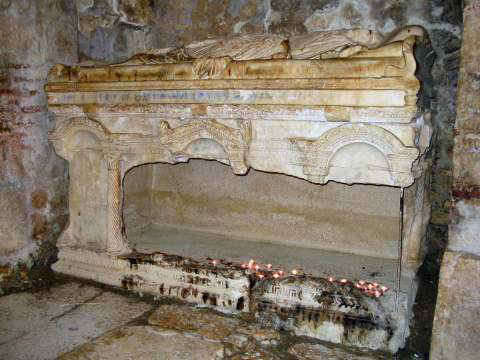
At the time Myra fell under Seljuk Muslim control, raiders from Italy stole the bones of St. Nicholas from his tomb (see picture at right, note where it was broken into) in his church and brought the bones to Bari. A few small pieces that were left behind are on display in the museum in Antalya.

There are some wonderful icons at the church in Myra, but unfortunately they are not in the best preserved shape. Still, the church is largely intact, and coupled with the wonderful rock-cut tombs and theater at nearby Demre is a wonderful place to visit should you get the chance.


For more on St. Nicholas of Myra check out:
Sain Nicholas on Wikipedia
St. Nicholas of Myra, Legends and Sources

Wednesday, December 06, 2006

Pope in Turkey

Well, I didn't see any news coverage as to what Pope Benedict ate during his recent trip through Turkey, but it was very interesting to me to follow his journeys to places I've both visited before and also written about in my novels.

First, Anıtkabir, the mausoleum of the modern Republic of Turkey's founder and first president, Mustafa Kemal Atatűrk -- is literally just a couple of blocks from where my husband grew up and I first lived in Turkey when we stayed with his parents. I haven't written about Anıtkabir in a story though...yet.

Then, near the Aegean Coast outside Ephesus, Meryem Ana Evi, or The House of the Virgin Mary -- I absolutely love Ephesus and this nearby site. If you ever go to Turkey, in my opinion, Ephesus is a must. Here's a link direct to Ephesus as well.

I have definitely used Meryem Ana in a story -- a story I started writing a few years ago. Now my fear is that it will seem I cashed in on the Pope's visit. Oh, well.

Although the Pope only briefly visited Haghia Sophia in Istanbul, it's a fabulous church/mosque/museum that I also highly recommend to anyone visiting Turkey. The history of this church, and its mosaics, are truly inspirational.

A couple of years ago, I visited the Met in New York City. Imagine my surprise when I turned around, and over the door in one of the rooms, found myself staring at a recreated mosaic from Haghia Sophia.

Haghia Sophia figures into the same story in which I used the House of the Virgin Mary. Across the street from Haghia Sophia is the Blue Mosque, Sultanahmet Camii, which the Pope also visited. I've used the Blue Mosque as a setting for another novel I've written.

Wonder if the Pope made it to the Covered Bazaar, and if he got invited to drink Turkish tea while examining a Turkish carpet? :-)
Related Posts Plugin for WordPress, Blogger...